Will They, Won’t They?
No deal between the US and Iran is imminent; therefore, reciprocal attacks could resume at any time, sending oil prices back to where they came from: $110/bbl basis Brent. While tensions could flare up again, the Persian Gulf and the Red Sea are currently relatively calm. Riding the wave of this dubious tranquillity are the vessels transporting oil out of the region, and the market is duly reacting to these welcome developments. With the Saudi East-West pipeline operational again, loading at the Red Sea oil hub of Yanbu has restarted. Crude oil exports by Middle Eastern producers averaged more than 16 mbpd in September, according to Kpler.
Crude oil availability is rising, but product supply, especially diesel, remains tight. The US administration, seemingly shelving its plan to ban US diesel exports, is encouraging EU nations to release critical agricultural and trucking fuel from strategic storage. The IEA, however, remains tight-lipped about any additional emergency release. Those expecting tangible progress in the peace talks have been wrong-footed several times over the past four months. Yet the economic cost of this senseless conflict for everyone involved is becoming unbearable and politically unsustainable by the day. Proof of it will come today in the form of the US core PCE data, which is expected to show a rise of 3.3%. Unfortunately, there are no signs of de-escalation; the horse-trading continues, and one can only hope that a mutually acceptable armistice is weeks, rather than months, away.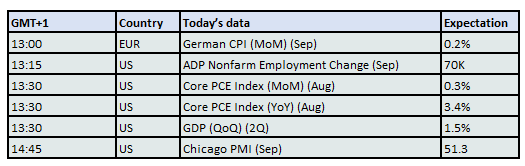
High Bond Yields are Here to Stay
Investors are taking the latest, seemingly ominous development in the financial markets with surprising, or perhaps even worrying, calm. Or, better put, those heavily involved in equities have a strikingly different view of the global and US economies than bond investors. They probably agree that the current snapshot offers an auspicious backdrop. Several institutions, including the IMF, expect the global economy to tick along reassuringly. Judging by the performance of equity markets, optimism prevails. On the other hand, take a look at bond yields, and the difference is stark.
The latest fault line emerged last week. Donald Trump is absolutely right when he claims that the US economy is ‘the hottest one in the world’. His view was supported by S&P Global, which showed that US businesses continue to boom. Its headline flash Purchasing Managers’ Index for September jumped from 56 in August to 58.4 this month, marking the fastest growth in five years. It was the fourth successive monthly acceleration.
The latest data was music to the ears of equity investors. The US economy is on solid footing; the Atlanta Fed expects growth to reach an annualised 5.1% in the third quarter. It is this conducive backdrop that is causing concern in the bond market. The hot economy triggered a sell-off in bonds, pushing yields higher. The two-year yield jumped to 4.955% this week, the 10-year, possibly the most salient benchmark worldwide, to 5.274%, its highest level since 2007, and the 30-year to 5.598%.
The two pivotal questions are why bond yields are rising and why the stock market is so resilient. The answer to the first is probably threefold. The wars in Ukraine and Iran have led to an energy crisis and pushed headline inflation higher in major economies around the world. When headline inflation rises, the core reading is bound to follow to a certain extent. There are no countries in the developed world that have a realistic chance of achieving the magic 2% target in the foreseeable future. (The only exception is Japan, although, given decades of deflation, inflation of around 1.9% is deemed comparatively high.)
Secondly, governments’ debt burdens are growing unstoppably. The $40 trillion public debt pile that the US sits on forces investors to demand higher interest rates to lend money to the government. Of course, going to war without tax increases, in other words, without the resources to finance it, will do nothing to alleviate the deficit. Thirdly, in the competition between the public and corporate sectors to borrow, it is the latter, driven by the unbroken faith in the AI sector, that has the upper hand. US Treasury bond auctions are undersubscribed.
As for the second question, favourable earnings, again greatly aided by the tech sector, are keeping equities supported. Additionally, because the US is currently ‘the hottest economy in the world’, foreign inflows into US equities are discernibly growing. The Bureau of Economic Analysis found that foreign investors spent $942 billion on US equities and investment fund shares between August 2025 and July 2026. As pointed out by the Financial Times, foreign investors remained net buyers for six successive months, and in the second quarter of this year alone, they splashed $426 billion on US equities and investment fund shares, a year-on-year increase of 62%.
How long will the chasm between bond and equity prices widen, or when will it start narrowing? Such a change does not seem imminent. Evidently, yields are not yet high enough to impede growth and cool inflationary pressures. This is probably one of the reasons why central banks will plausibly continue to increase borrowing costs in the coming months.
And how is oil affected by the current high-yield, rising-interest-rate environment? It is a simple question with tricky answers. The demand side of its equation should not suffer, logic dictates. We have just established that global growth prospects are solid, with the US being the bellwether. It is price supportive. Elevated borrowing costs, which are a significant part of the cost-of-carry formula, do not incentivise stock builds; consequently, backwardation could remain stubborn. On the other hand, stable-to-rising US interest rates strengthen the dollar, which might dent demand outside the US. Additionally, liquidity problems in the bond market might be mitigated by selling liquid assets, such as oil.
Ultimately, the current inverse relationship between equities and bonds, and between oil and bonds, might make a sharp U-turn once oil flows through the Strait of Hormuz, the Bab el-Mandeb Strait, and the Suez Canal/Sumed pipeline resume uninterruptedly, pushing oil prices down, easing inflationary pressure and providing invaluable leverage for central banks, which would no longer have to raise interest rates. By extension, it is the Middle East that will set interest and mortgage rates and shape inflation and consumer spending for some time to come.
Overnight Pricing

30 Sep 2026
